

Choosing tactics without loosing your GD mind
Why “we need every channel” is usually the wrong question.
Raise your hand if you’ve been personally victimized by someone who said any or all of the following:
We should post more on social.
We should launch paid.
We should refresh the website.
We should try influencers.
We should do email.
We should do PR.
We should do events.
I get it, there’s a wild world of activities out there and then the well-intended assumption is that brand building = stacking tactics and getting some massive ROI. But that’s not how brands grow, and it’s not how real strategy is built (but it is how pockets of waste are born). The teams who break out of this cycle all do the same thing: they stop thinking in terms of channels and start thinking in terms of outcomes and audience behavior.
Let’s talk about what that shift looks like.
The checklist trap
Many brands (hi startup friends!) try to operate like fully staffed marketing departments long before they have the resources or clarity to justify it. They inherit the industry’s to-do list and feel like they’re failing if they can’t execute all of it. (But Pepsi did it so we should do with only a $50,000 budget, right? RIGHT?)
Brand building is a sequencing problem, not a volume problem. The leanest of teams can actually kill it with limited resources if they do the right thing. Just look at Good Girl Snacks! IKYMI: they started their entire CPG company off of some organic TikToks, and blew out of their pre-sales.
The more rigid the budget and the smaller the team, the more painful this becomes. You can’t do everything, and you shouldn’t: not all tactics matter equally, and most don’t matter at all until you’ve hit specific strategic thresholds.
The only questions that matter
Before you pick a tactic, I’ve got 3 questions for you:
What does the brand need right now? Not in theory, not across a five-year roadmap. Right freakin now. Trust? Awareness? Pipeline? Adoption? Retention? (the answer is not all of them please, for the love of god spare me)
How does your audience actually behave? Where they learn, validate, and make decisions. Not where you personally want to show up bc you think Threads is cool.
What can you execute consistently without burning out the team? A mediocre tactic you sustain is better than a “best practice” you touch twice and abandon. What can your resources actually do really well right now?
Different goals require different tools
Brands usually fall into one of four immediate goals, each with its own playbook. In no particular order:
1. Credibility: When you need to prove legitimacy. Early-stage startups and companies in trust-sensitive spaces (healthcare, cybersecurity, finance) live here.
Case studies
Founder POV (@ me for Founder LinkedIn support :) )
Social proof (we love a good testimonial!)
Earned media (but stop pitching boring ideas)
A (thoughtfully designed) website
2. Awareness: When you need net new attention from the right people.
Organic social built for distribution
Partnerships
Influencers
Video or serialized content
Category conversations
3. Pipeline / demand gen: When you need cheddar, action, conversion.
Paid social + retargeting
Paid search
Landing pages that remove friction
Problem-oriented content
4. Affinity / loyalty: When keeping customers (retention) matters more than getting new ones (reach).
Email
Community
Content series
Events (offline or digital)
Customer features and POV
Different goals = different mechanics. No brand needs all of them at once.
Map goals to behaviors for super focus
Brands create pockets of waste by focusing on available tactics vs how their audience buys.
A B2B SaaS founder is not getting found via Instagram Reels.
A consumer wellness brand selling an emotional transformation is not converting through a whitepaper.
A local services business will live and die by search and reputation.
(Also… how tf do you know what to measure if you aren’t mapping what you’re doing to plausible outcomes?)
The real advantage for small teams
When you stop chasing the master checklist, the work gets cleaner:
You only pick tactics that: match your brand’s stage, your audience’s observable habits, and the resources you have to get closer to the outcome that matters.
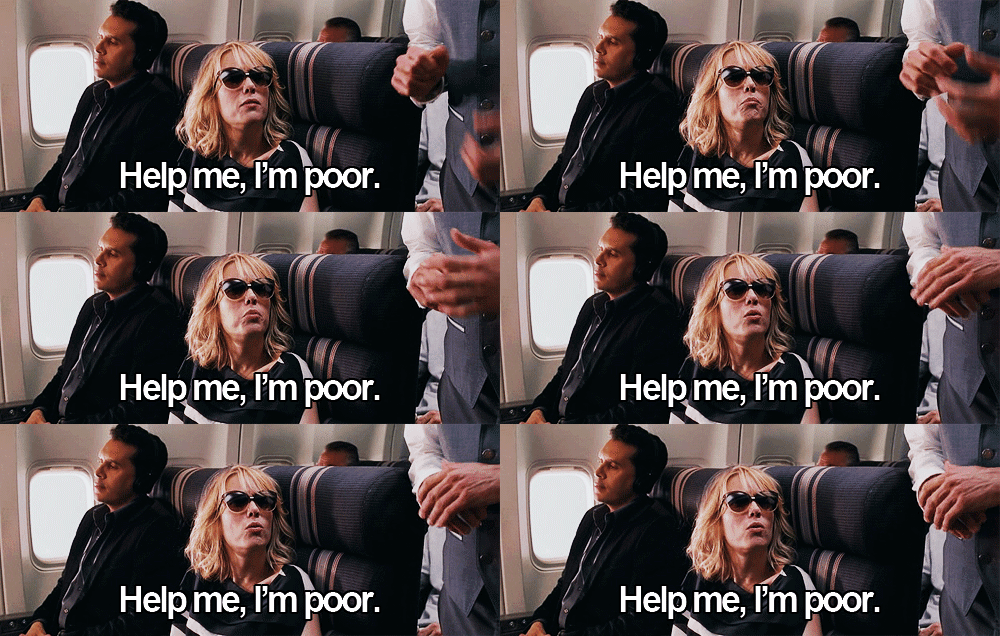
Small teams don’t lose because they lack sequencing. It’s not because they just need more hands to do all the things. Trust me, even large well-equipped teams are struggling with pockets of waste. Trusssst me.
Think more about what you can ignore vs. what you feel like you should be doing. If you can figure out what your brand needs, how your audience buys, and what your team can sustain, you shortcut the chaos and have some ownership / focus of what you’re actually doing. Welcome to a brand that grows and a marketing team (or founder team!) that’s no longer drowning.
✌️ Kara
Just for fun
Hot jobs
Senior Marketing Manager, Paid Social and Brand Media @ The Bouqs Company
Head of Marketing - B2B @ Legal Karma
Organic Social Specialist @ Kulfi
Manager of Fan Engagement & Insights @ League One Volleyball
Creative Director @ Eve
Demand Gen, ABM & Lifecycle @ Metronome
Strategist @ Gorilla 76
Head of Marketing @ ChowNow
Partnerships Lead @ Fazit
Senior Marketing Manager @ Communities Foundation of Texas
Offline Marketing Manager - Podcast @ Right Side Up
Senior Account Manager, Apps @ Google
Senior Associate Business Development - Marketing Solutions @ LinkedIn
Senior Director of Strategic Communications @ Justworks
Product Marketing Manager @ PayNearMe
Digital Marketing and Audience Editor @ The TRiiBE
Senior Marketing Manager @ LivTech
Retention Marketing Manager @ Faire
The sequencing framing is spot on. Too many teams burn out trying to be everywhere at once when they havnt even figured out what outcome they're chasing. The four goal framework really simplifies the decision making proces.